#include <NetlistEdge.hpp>
Public Member Functions | |
| NetlistEdge (NetlistNode &sourceNode, NetlistNode &targetNode) | |
| auto | setEdgeKind (ast::EdgeKind kind) |
| auto | setVariable (SymbolReference const *sym, DriverBitRange newBounds, ast::EdgeKind kind) -> bool |
| auto | hasSymbol () const -> bool |
| True if this edge carries a symbol annotation. | |
| void | disable () |
| Public Member Functions inherited from slang::netlist::DirectedEdge< NetlistNode, NetlistEdge > | |
| DirectedEdge (NetlistNode &sourceNode, NetlistNode &targetNode) | |
| auto | operator= (const DirectedEdge< NetlistNode, NetlistEdge > &edge) -> DirectedEdge< NetlistNode, NetlistEdge > &=default |
| auto | getSourceNode () const -> NetlistNode & |
| Return the source node of this edge. | |
| auto | getTargetNode () const -> NetlistNode & |
| Return the target node of this edge. | |
Public Attributes | |
| ast::EdgeKind | edgeKind {ast::EdgeKind::None} |
| SymbolReference const * | symbol {nullptr} |
| DriverBitRange | bounds |
| bool | disabled {false} |
Additional Inherited Members | |
| Protected Member Functions inherited from slang::netlist::DirectedEdge< NetlistNode, NetlistEdge > | |
| auto | isEqualTo (const NetlistEdge &edge) const -> bool |
| auto | getDerived () -> NetlistEdge & |
| Protected Attributes inherited from slang::netlist::DirectedEdge< NetlistNode, NetlistEdge > | |
| NetlistNode & | sourceNode |
| NetlistNode & | targetNode |
Detailed Description
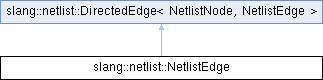
A class representing a dependency between two nodes in the netlist.
The driven symbol annotation is stored as a pointer into the owning NetlistGraph's SymbolTable so that many edges referring to the same hierarchical symbol share a single backing record.
Constructor & Destructor Documentation
◆ NetlistEdge()
|
inline |
Member Function Documentation
◆ disable()
|
inline |
◆ hasSymbol()
|
inline |
True if this edge carries a symbol annotation.
◆ setEdgeKind()
|
inline |
◆ setVariable()
|
inline |
Associate a driven symbol, bit range and edge kind with this edge.
One edge describes a single symbol over a single contiguous range at a single edge kind, so an annotation is only absorbed when it agrees with the stored one: same symbol, same edge kind, and a range contiguous (abutting or overlapping) with the stored range, which is widened to the union of the two. Returns true if the annotation was set or merged, and false if it disagrees, in which case the caller must put it on a parallel edge rather than overwrite what is already here.
These are the same attributes NetlistGraph::mergeParallelEdges groups on, so an edge set built through this function is merged consistently.
Symbol identity is by pointer: the SymbolTable interns each hierarchical path to a single canonical record, so equal paths share the same pointer.
Member Data Documentation
◆ bounds
| DriverBitRange slang::netlist::NetlistEdge::bounds |
◆ disabled
| bool slang::netlist::NetlistEdge::disabled {false} |
◆ edgeKind
| ast::EdgeKind slang::netlist::NetlistEdge::edgeKind {ast::EdgeKind::None} |
◆ symbol
| SymbolReference const* slang::netlist::NetlistEdge::symbol {nullptr} |
The documentation for this class was generated from the following file:
- netlist/NetlistEdge.hpp